Showing posts with label Christmas shopping. Show all posts

Saturday, 18 September 2021

#SelfPromoSaturday September Sale!

There's currently a sale running  on the ACE Gamebooks Roleplay page, over on DriveThruRPG, where select items are available for up to 30% off their recommended retail price.

If you've not yet checked out 'TWAS - The Roleplaying Game Before Christmas, now would seem like the perfect time to do so. Please note, the sale runs until 9:00am next Saturday, 26 September 2021.


Tuesday, 24 December 2019

The Krampus Kalendar: X is for XMAS EVE

Every Christmas Eve, children the world over await the arrival of one individual more than any other (or at least one of his many lieutenants) with excited anticipation. The image of the jolly old man with his long white beard, red suit and attendant reindeer couldn’t be more familiar, but where did this admittedly peculiar figure come from? Who is, or was, the real Father Christmas?

Whether you call him Father Christmas, Santa Claus, Sinterklaus or Kris Kringle, the semi-historical, semi-legendary figure who inspired the Christmas gift-giver children know and love today was one Saint Nicholas. And he didn’t come from the North Pole or Lapland. Saint Nicholas came from Turkey (although, of course, turkeys come from Mexico)!

Nicholas was the Greek Orthodox Bishop of Myra in fourth century Byzantine Anatolia. His parents both died when he was still a young man, leaving him a considerable fortune. Shunning his wealth and privileged background to join the Church, Nicholas then made it his mission to give his riches away to those more deserving, and in greater need, than he. The most well-known example of his charity is the one which led to children hanging up their stockings on Christmas Eve for Santa to fill with gifts.

But the image we now have of Father Christmas has its origins in more than just the legendary life of one particular saint. In truth, Father Christmas’s origins go back much further than fourth century Turkey. For the Norsemen of Scandinavia, the season of Yule was as much a dark time ruled over by demons and malevolent spirits. It was best to stay indoors, to escape the baleful gaze of the nocturnal flyer Odin. Odin also brought winter to the world. In this guise he was accompanied by his Dark Helper, a demonic horned creature who punished wrong-doers. This figure would resurface later as Father Christmas’s assistant.

Thor, the Norse god of thunder, may well have had a hand in influencing the development of the Father Christmas myth, for he rode across the sky in an iron chariot pulled by two huge goats, called Tanngrisnir and Tanngnjóstr (in English, Gnasher and Cracker), rather like Santa’s sleigh, with its team of reindeer.

There is also evidence that pagan peoples once worshipped an elemental spirit called Old Man Winter. He too went into the mix that was to eventually produce the figure of Father Christmas.

Father Christmas has an important part to play in 'TWAS - The Krampus Night Before Christmas, the latest title in the ACE Gamebooks series, and is available to buy now. If you've already bought it and read it, please do post a review on Amazon, Goodreads, or wherever.


To find out more about the festive season and its many traditions, order your copy of the Chrismologist's Christmas Explained: Robins, Kings and Brussel Sprouts today!

The book is also available in the United States as Christmas Miscellany: Everything You Ever Wanted to Know About Christmas.


Monday, 23 December 2019

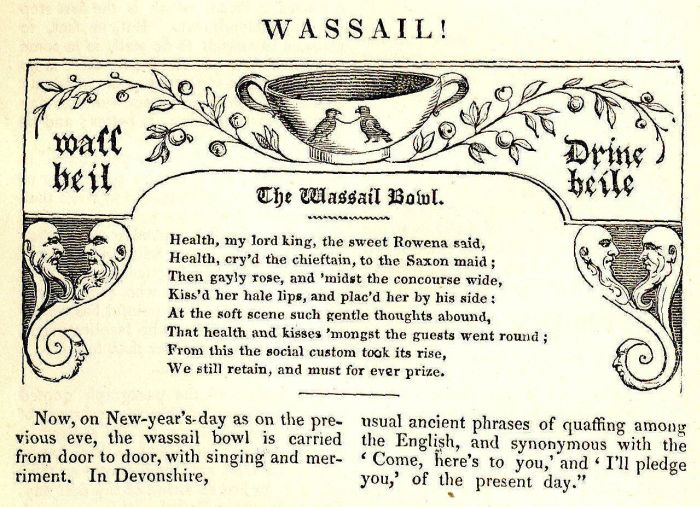
The Krampus Kalendar: W is for WASSAIL

Wassailing used to be a popular part of the Christmas festivities in England and the memory of it still lingers in the words of certain carols, but what was wassailing, and how exactly did people go about it?

Wassail itself was a hot drink which pre-dates the Christian festival by some centuries. The word ‘wassail’ comes from the Old English wæs hæl which literally meant ‘be whole’ and so, by extension, ‘be healthy’. The phrase ‘hale and hearty’ has its origins in this expression as well.

The ceremony from which wassailing developed was a toast to the sun as it rose on the morning after the shortest day of the winter solstice. It, like the veneration of evergreens, was believed to encourage a bountiful harvest (specifically that of fruit) in the year to come.

The transformation of the winter festival to a Christian one did nothing to diminish the popularity of the wassail toast and it persisted, like so much else, becoming interwoven with the newer Christianised celebrations.

In Saxon England, at the start of the year, the lord of the manor would shout the greeting wæs hæl to his assembled household who would respond with the words drinc hæl, meaning ‘drink and be healthy’. His lordship would then take a swig from a large wooden bowl – the Wassail Bowl or Wassail Cup – before passing it on to the next most senior member of the household. And so it would be passed down the line until everyone had had a drink.


'TWAS - The Krampus Night Before Christmas is available to buy now, and if you've already read it, please do post a review on Amazon, Goodreads, and anywhere else you can think of.


To find out more about the festive season and its many traditions, order your copy of the Chrismologist's Christmas Explained: Robins, Kings and Brussel Sprouts today!

The book is also available in the United States as Christmas Miscellany: Everything You Ever Wanted to Know About Christmas.


Sunday, 22 December 2019

The Krampus Kalendar: V is for a VERY Merry Christmas

The word ‘merry’ now has all sorts of connotations connected with it to do with being slightly intoxicated, but how did the seasonal salutation come to be in the first place? And for how long have Christmases been merry?

‘A Merry Christmas and a Happy New Year to You’ was the verse that Sir Henry Cole chose to put on his first commercially available Christmas card in 1843, although the phrase was already in use almost 300 hundred years before that, appearing as it does in The Hereford Municipal Manuscript of 1565:

And thus I comytt you to god, who send you a mery Christmas & many.

The word ‘merry’ has its origins in the Old English word myrige, meaning ‘pleasing’ or ‘delightful’. By the sixteenth century there were a number of phrases in everyday use that included the word – ‘make merry’ (circa 1300), ‘Merry England’ (circa 1400) and ‘the merry month of May’ (1560s) – in which it meant ‘pleasant’ or ‘agreeable’. However, by the nineteenth century it had taken on its more familiar meaning of ‘jovial and outgoing’.

Another familiar Christmas usage of the word ‘merry’ is in the English carol ‘God Rest Ye Merry, Gentlemen’, first published in William Sandys’ Christmas Carols Ancient and Modern in 1833. The carol probably existed as a folk-song long before it was written down, and the phrase ‘rest you merry’ appears in The Dictionary of syr Thomas Eliot knyght, of 1538:

Aye, bee thou gladde: or joyfull, as the vulgare people saie Reste you mery.


'TWAS - The Krampus Night Before Christmas is available to buy now, and I'm pleased to say that 'TWAS - The Roleplaying Game Before Christmas has funded on Kickstarter.


To find out more about the festive season and its many traditions, order your copy of the Chrismologist's Christmas Explained: Robins, Kings and Brussel Sprouts today!

The book is also available in the United States as Christmas Miscellany: Everything You Ever Wanted to Know About Christmas.


Saturday, 21 December 2019

The Krampus Kalendar: U is for UNPREPARED

Not matter how hard you try to be prepared, more often than not you’ll find yourself braving the chaos of the Christmas Eve last minute shopping spree, either in order to pick up that essential festive gift for the dog or another jar of gravy powder.

But before you dash off to the local garage to buy that special someone another chocolate orange, bear in mind that if you've already left your Christmas shopping a little late, you risk paying up to 50% more than those people who are – how shall we put it? – a little better organised.


A survey of Christmas shoppers conducted in 2013 revealed that 16-24 year-olds are actually the most organised when it comes to getting the Christmas shopping done, with nearly 44% of them buying their festive gifts in, or even before, November! Those aged 45 or older are the ones who are more likely to leave it to the last minute with almost a third not even starting on the seasonal shop until the week before Christmas.

When you look at the gender of last minute shoppers, rather than their age, one quarter of men do most of their Christmas shopping at the last possible moment, while half of all women have it done before the first week of December.

15% of shoppers cashed in their store loyalty coupons and vouchers to cover the cost of their purchases, while one in ten of those surveyed planned so far ahead that they actually bought their first Christmas present for December 2013 in the January sales! The people surveyed made an average five trips to the shops to get their Christmas shopping done, while one in ten didn’t shop in-store over the Christmas period at all, preferring to do so from the comfort of their laptop, tablet or smartphone!

It might not be too late to order a copy of 'TWAS - The Krampus Night Before Christmas, if you need a last minute stocking filler for something, but time is definitely running out for 'TWAS - The Roleplaying Game Before Christmas, which finishes its run on Kickstarter at 11:59pm tonight!


To find out more about the festive season and its many traditions, order your copy of the Chrismologist's Christmas Explained: Robins, Kings and Brussel Sprouts today!

The book is also available in the United States as Christmas Miscellany: Everything You Ever Wanted to Know About Christmas.


Wednesday, 11 December 2019

The Krampus Kalendar: K is for KRAMPUS

In the twenty-first century, we have become so used to the idea of Santa bringing gifts to good little boys and girls on Christmas Eve it is easy to forget that not so long ago, bad little boys and girls were likewise punished.

In the wild heartlands of Europe such legends are not so easily forgotten, and so it is that in countries such as Austria and Hungary, on 5 December, communities remember Krampus, a demonic anti-Santa who accompanies St. Nicholas during the Christmas season, warning and punishing bad children.


In the Alpine regions, traditionally young men dress up as the Krampus and roam the streets, frightening children and women with rusty chains and clanging bells. In some rural areas the tradition goes so far as to include the birching of young girls!

Images of Krampus usually show him with a basket on his back, used to carry away bad children and dump them into the pits of Hell. The name Krampus itself originates from the Old High German word krampen, meaning ‘claw’.

So when the chubby, cheery fellow with the bulging sack of presents asks if you've been good or bad, you had better have been good, for goodness sake…

Krampus is the Big Bad of both the gamebook 'TWAS - The Krampus Night Before Christmas and the roleplaying game 'TWAS - The Roleplaying Game Before Christmas, which is currently funding on Kickstarter.


To find out more about the festive season and its many traditions, order your copy of the Chrismologist's Christmas Explained: Robins, Kings and Brussel Sprouts today!

The book is also available in the United States as Christmas Miscellany: Everything You Ever Wanted to Know About Christmas.