"The modern master of the gamebook format" (Rob Sanders)... "Can do dark very well" (Jonathan Oliver)... "Green gets mileage out of his monsters" (SFX Magazine)... "It takes a firm editorial hand and a keen understanding of the tone of each piece to make a collection this diverse work, and Green makes it look effortless" (Starburst Magazine)... "A charming blend of camp creatures, humour, and genuine horror" (Set the Tape)
Forty-one years ago today, at 5:00pm on 21st November 1984, the BBC dramatisation of John Masefield's The Box of Delights was first broadcast. I was one of those eager children who tuned in to watch and was hooked from the moment I heard Victor Hely-Hutchinson's orchestral arrangement of The First Nowell, taken from the third movement of his Carol Symphony, which formed the series' theme music.
"As
a lifelong roleplayer I was genuinely interested to read an RPG based on The
Box of Delights. I was pleased to find that Jon Green has done an excellent job
of capturing the spirit of the piece in a tight, narrative framework that
emphasizes storytelling and keeps the mechanics simple enough to be
enjoyed by any age. I may run it for my own kids."
Devin
Stanfield, Kay Harker in the 1984 BBC Television adaptation of The Box of
Delights.
Designed to be picked up and played with minimal preparation, it nonetheless includes a well-developed character creation system, as well as rules for combat and magic.
Illustrated throughout by Tony Hough, it is ideal for a festive gaming session with an established group, or as an alternative to the family games usually played at Christmastime.
Time and Tide and Buttered Eggs wait for no man. So, grab your dice and playing cards, and prepare for adventure, for the Wolves are Running!
The book is in full colour and features Tony Hough's incredible illustrations throughout. At the moment, only the PDF is available, but print copies will be available in the New Year.
It was touch and go for a while whether I would actually be able to complete The Box of Delights RPG; it was originally going to be a supplement for the 'TWAS RPG, and when I decided it would be a self-contained RPG, I did not expect it to be as long as 'TWAS or Heorot. However, it has ended up being longer than either!
.
“And now, Master Harker, of Seekings,” the old man said, “now that the Wolves are Running… perhaps you would do something to stop their Bite?”
When Kay Harker returns home from boarding school for the Christmas holidays he meets a mysterious Punch and Judy Man, and finds himself mixed up in the battle to possess a magical Box. This curious artefact allows its owner to shrink, fly swiftly, travel into the past, and experience all the wonders that are contained within the Box itself.
Having been entrusted with the Box by the Punch and Judy Man, Kay finds himself being hunted by the wizard Abner Brown and his gang of clerics-cum-jewel thieves. But Abner does not only covet the Box – he also seeks to stop Tatchester Cathedral celebrating its 1,000th Christmas Midnight Mass.
It is up to Kay and his companions, the Jones children, along with various otherworldly allies, to thwart Abner Brown’s plans and stop him acquiring the Box of Delights and with it, power beyond imagining.
The Box of Delights - The Roleplaying Game is a rules-lite RPG for 2-6 Players, plus a Gamesmaster, inspired by John Masefield's Christmas classic, and licensed from the John Masefield Estate.
Designed to be picked up and played with
minimal preparation, it nonetheless includes a well-developed character
creation system, as well as rules for combat and magic. It is ideal for a
festive gaming session with an established group, or as an alternative to the
family games usually played at Christmastime.
But
Time and Tide and Buttered Eggs wait for no man. So, grab your dice and playing
cards, and prepare for adventure, for the Wolves are Running!
"As
a lifelong roleplayer I was genuinely interested to read an RPG based on The
Box of Delights… Jon Green has done an excellent job capturing the spirit of
the piece in a tight, narrative framework that emphasizes storytelling and
keeps the mechanics simple enough to be enjoyed by any age."
Devin
Stanfield, Kay Harker in the 1984 BBC Television adaptation of The Box of
Delights
I couldn't let the landmark 60th anniversary of the world's longest running science ficiton TV show go without a mention.
Ten years ago I was watching The Day of the Doctor at the cinema with my kids. Today, I've watched a couple of old episodes from the Third Doctor's era*. And at the weekend I will sit down to watch the first of the 60th anniversary specials.
Tom Baker was my first Doctor, although I later saw quite a few of John Pertwee's adventures when they were repeated on BBC2. I have been a fan ever since. I found things to enjoy about every era, and while I didn't appreciate Chris Chibnall's stint as showrunner, I still watched every episode. But I am optimistic for David Tennant's return and whatever comes after.
When Doctor Who wasn't on TV, I read Virgin Books New Adventures. I even pitched one, although it was politely rejected.
My involvement with Doctor Who as an author didn't begin until 2007, when I contacted Puffin Books about writing a Decide Your Destiny Doctor Who gamebook. This lead to me being commissioned to write The Horror of Howling Hill. Over the next decade I wrote for the Tenth, Eleventh and Twelfth Doctors, and contributed to Doctor Who: 100 Illustrated Adventures and wrote the lion's share of the Doctor Who Annual 2010.
Doctor Who: Decide Your Destiny: The Horror of Howling Hill (2008)
Some of you may remember that back in 2016 I wrote a novelisation of the unmade Robin of Sherwood TV movie The Knights of the Apocalypse.
If you're a fan of the seminal '80s sword and sorcery TV series, or even if you've never seen a single episode before, you might be interested to know that the show is being repeated, from the beginning, from 13th July on ITV4.
I'm loving Mark Gatiss and Steven Moffat's take on Dracula and am looking forward to the final part of BBC 1 this evening, and it's got me thinking about adaptations of classic stories.
The BBC has broadcast adaptations of four such stories recently, three true classics - H. G. Wells' The War of the Worlds, Charles Dickens' A Christmas Carol, and Bram Stoker's Dracula - and one modern classic, Philip Pullman's His Dark Materials.
The whole family was gripped by His Dark Materials, which even had the kids looking up from their phones, and I loved Lorne Balfe's score. The score was the best bit about The War of the Worlds, and I religiously fell asleep every Sunday night whilst watching it. The jury's still out on A Christmas Carol - how much can you take away from a classic story before it is no longer recognisably the same story - but at least it held my attention.
I have spent the last five years producing my own gamebook adaptations of a number of classic stories, some of which are more like re-imaginings than straight adaptations - NEVERLAND - Here Be Monsters!being a case in point - while others are much closer to the original source material, like Beowulf Beastslayer. But no matter what I have done with the stories, I have always tried to ensure that I hit all the beats people would expect.
It just so happens that the sixth ACE Gamebook will be Dracula - Curse of the Vampire, and may be my closest adaptation yet. By the way, the Kickstarter campaign launches on Sunday 1st March 2020, with special rewards on offer for those people who back within the first 24 hours.
It was with no small amount of relief that on watching the BBC's Dracula I realised that it goes in a very different direction from my version, which allows you to play as the eponymous Count himself, and has diverged from the original novel massively. However, this has not been to its detriment; if anything it has reinvigorated the story and made it horrifying again*. All the important characters are still in place, but Gatiss and Moffat continue to surprise and intrigue the viewer throughout.
"You have something in your eye."
Where the BBC's adaptation of The War of the Worlds went wrong, I believe, is that some of the changes that were made were utterly illogical - for example, the levitating heat-ray thing - but worse than that, it was boring. And it's quite a challenge to make H. G. Wells' classic about an alien invasion of Earth that dull. While I'm still undecided about taking so much of Dickens out of A Christmas Carol, at least it wasn't boring**.
The Box of Delights is a children's fantasy novel by John Masefield, remembered as much for the BBC's 1984 dramatisation of it. In the story, Kay Harker returns from boarding school only to find himself mixed up in a battle to possess a magical box, which allows the owner to go small, go swift, experience magical wonders contained within, and travel into the past.
The dramatisation is noted for its Yuletide atmosphere (it is set during Christmas, after all) and has become something of a nostalgic treat for followers of cult TV. The seasonal theme music is Victor Hely-Hutchinson's wonderful orchestral arrangement of "The First Noël" from his Carol Symphony.
If you've never seen it, it's worth checking it out, and if you remember it fondly from your childhood, as I do, enjoy the following clip as you take a trip down memory lane and recall a creepy children's Christmas classic...
I am delighted to be able to share with you the finished cover for Beowulf Beastslayer, featuring Russ Nicholson's astonishing artwork.
I am particularly thrilled about the cover quote written by one of my TV heroes, Dr Janina Ramirez, who has her own book about Beowulf coming out in September.
The second cover quote is by another academic, who also happens to be one of the backers of the original Kickstarter, Prof. Dr. Oliver M. Traxel.
A had a surprise on Facebook on Wednesday when I was tagged on Facebook, on a post showing a series of stills from Channel 4's 24 Hours in A&E. Why had I been tagged? Because the photos showing a man in the waiting room playing a Fighting Fantasy gamebook to help pass the time, and the gamebook in question was Stormslayer*.
Was this you? If it was drop me a line!
Talking of my Fighting Fantasy gamebooks, of the seven I have written, one was illustrated by Stephen Player (Stormslayer), one was illustrated by Alan Langford (Spellbreaker), two were illustrated by Tony Hough (Knights of Doom and Bloodbones), and three were illustrated by Martin McKenna (Curse of the Mummy, Howl of the Werewolf, and Night of the Necromancer).
Martin has recently listed a number of his Fighting Fantasy illustrations on ArtPal, including the covers he produced for the Wizard Books' edition of Bloodbones and Spellbreaker. You can marvel at his artistry here and order prints of his illustrations yourself.
While we're on the subject of Spellbreaker, next month marks 25 years since its publication. To commemorate the occasion I will be running a prize draw at the UK Games Expo next weekend. If you buy a book from me over the course of the three days, you will be entered into the prize draw for a chance to win a signed, limited hardback collector's edition of my latest gamebook, NEVERLAND - Here Be Monsters!
* Penned by Yours Truly, in case you didn't already know.
According to Twitter, today is Dinosaur Day. My working days are filled with dinosaurs at the moment, as I'm nearing the end of writing the first draft of NEVERLAND - Here Be Monsters!
Like many 5 and 6 year-olds, I was obsessed by dinosaurs. I would spend hours tracing the dinosaurs in the colouring book I had, and I loved films like The Land That Time Forgot, Valley of the Gwangi, and One Million Years BC, shown on TV during the afternoon at weekends. When I was a little older, by father and I would make Airfix kits of dinosaurs together, and I have very fond memories of travelling up to London on the train with him, specifically to visit The Natural History Museum and its dinosaur collection. I even remember an English lesson, early on in Secondary School, in which we studied an extract from Ray Bradbury's A Sound of Thunder, focusing on the arrival of a T-Rex.
All of this clearly had an impact on my growing up, and I still have a passion and fascination for prehistoric life today. Last year family Green visited New York and I dragged everyone to the American Museum of Natural History, just so that I could see the dinosaur exhibits, which did not disappoint! And because it had an impact on me growing up, it has also impacted upon my writing.
But I have never explored dinosaur life in so much detail as I have in NEVERLAND - Here Be Monsters!For a start, the book includes over 30 different dinosaurs, marine reptiles, flying reptiles and other prehistoric creatures. But one of the fun things about writing the book has been coming up with new names for dinosaurs, because most of the characters in the story wouldn't have known what the nascent fossil hunters had called these primeval beasts.
I'm keen for the book to be finished and out there in readers' hands for various reasons, but one of them is to see if people can work out which dinosaur is which. Maybe I'll reveal the answers next Dinosaur Day.
I only discovered today that Charles Dickens' perennial favourite A Christmas Carol was published on this day* in 1843! And it just so happens that my latest novella, which was inspired by the tale of Ebenezer Scrooge and the Three Spirits, is almost ready to be unleashed upon the world.
It is an idea that I've wanted to work on for a long time and I was starting to make more concrete plans back in 2013. However, other work commitments meant that it kept getting pushed back, or when I thought of working on it again there simply wasn't enough time to get it done in time for Christmas on the year in questions. The BBC's historical mystery drama Dickensian, which ran over the Christmas period in 2015, also put the kibosh on the project, for a while at least, as I didn't want people thinking I'd nicked the idea from there**.
But this autumn I made a commitment to myself to have the first Scrooge and Marley (Deceased) story ready in time for Christmas, and it very nearly is. To whet your appetite, here's the introductory blurb:
A year on from the events of Charles Dickens’ A Christmas Carol, Ebenezer Scrooge finds himself visited once again by the ghost of his late business partner, Jacob Marley, who brings with him a new proposition. Just as Marley helped Scrooge to avoid the cruel fate that the last of the Three Spirits foretold, Marley wants Scrooge to help him reduce his time in Purgatory. And so begins an epic adventure that will see the former friends face off against all manner of phantasms, freaks and fiends, with only one thing at stake…
Everything!
It's not the first time I've supplanted characters from other classic Dickens' novels and put them into A Christmas Carol. I did it back in 2001, when I turned the novella into a play that was performed at the school where I was working at the time. I wonder if that's when the seed for Scrooge and Marley (Deceased) was first planted.
It's crazy to think that since the epic 50th anniversary The Day of the Doctor event four years have passed, during which time I have had not only the Doctor Who: Time Lord Quiz Quest published but also my second Doctor Who Choose the Future gamebook, Night of the Kraken.*
And the most recent Doctor Who-related release that I have contributed to is Doctor Who: 100 Illustrated Adventures, which makes the perfect Christmas gift for the Doctor Who fan(s) in your family.
* Not to mention Terrible Lizards being published as a standalone story.
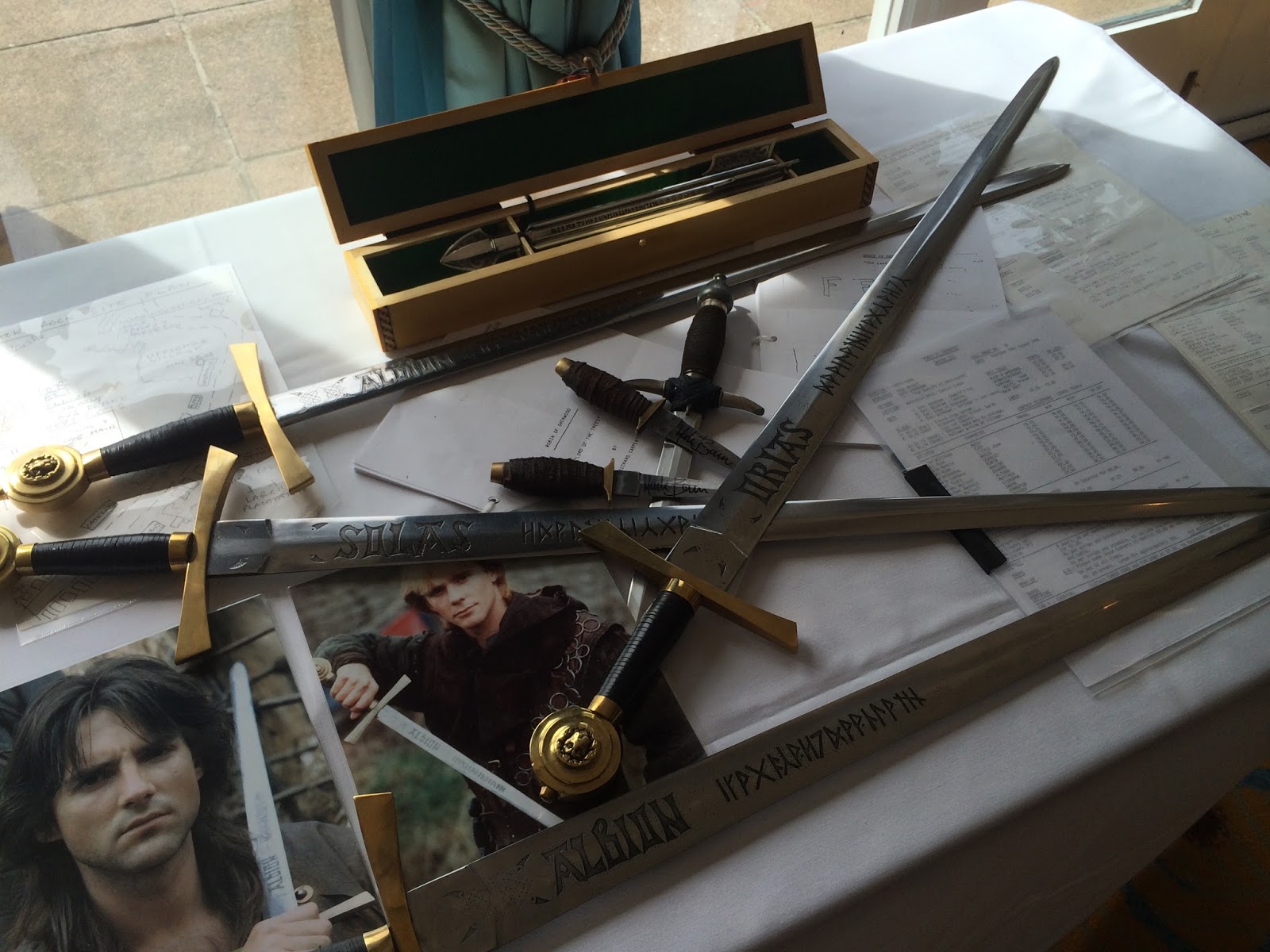
One of the more unusual, unexpected, and unforgettable gigs of my writing career (which is 25 years young this July) was being invited to write the novelisation of Richard 'Kip' Carpenter's unmade teleplay for Robin of Sherwood: The Knights of the Apocalypse.
Whilst writing it early last year, and immersing myself in all things Sherwood again, I was reminded of various landmarks in my life that featured the very best interpretation of the Robin Hood legend on screen, ever!
I was a teenager when the series was first televised. I remember balmy summer evenings, making sure I was back home after playing with my friends in the street to watch Robin of Sherwood, and having to draw the curtains to avoid the sunlight reflecting off the tiny TV screen. I was oblivious at the time to the fact that a fair proportion of the viewing public would be watching it for the tousled, '80s-mullet good looks of the lead actor(s)* - I tuned in to enjoy stories of action and adventure, of derring-do and dastardly deeds, of mysticism and paganism.
It was the magical and supernatural elements of the show that appealed to me the most, and what made the programme so different from all the other on-screen iterations. I thought the addition of the pagan shaman Herne was inspired, I couldn't quite believe the Baron de Belleme was about to carry out a satanic sacrifice on what was purportedly a children's show in Robin Hood and the Sorcerer, I was chilled by the appearance of Cromm Cruac, and I thrilled at the arrival of the gigantic wolf's head in The Time of the Wolf. I particularly delighted at the twist ending to the episode Rutterkin. But most of all I was blown away by The Swords of Wayland, with the angelic figure of Lucifer being summoned via the method of reversed-wax-melting.
When Robin of Sherwood was on, the Sunday morning after would find my friends and I in the local church choir dissecting the incidents of the previous night's episode when we were supposed to be getting ready to sing the anthem at the Eucharist.
Jump forward a few years and I found myself sharing a house with nine other young people in Leamingston Spa, all of us students of Warwick University. It turned out that I wasn't the only one upon whom Robin of Sherwood had made such a big impact. My friend Mike - who everyone called Bez at the time, as you do - was also a fan. Saturdays would often find us trawling the local video hire shop for shockingly-bad horror movies to watch that evening.
But one particular day we made a diversion to WHSmith, where we found Robin of Sherwood on sale in VHS format. Being poor, impoverished students, we decided to go halves on The Swords of Wayland two-parter. Taking it back to our rented house, we watched it for the first time since it had been on TV half a decade or more before - and it was just as good as we all remembered, if not even better, because our mutual friend Dave had a much bigger TV than my parents did at home.
When the time came to leave university, I somehow managed to inherit The Swords of Wayland (I'm still not sure how or why) and it inspired me to shell-out some of my hard-earned cash (I was a published author by then) to buy all three series on video, which were replaced, in time, by DVD box sets.
Robin of Sherwood had a big impact on my writing career, long before I came to write The Knights of the Apolcalypse novelisation. My first published book, the Fighting Fantasy adventure gamebook Spellbreaker, features a band of outlaws, each bearing a moniker that could have easily described one of Kip Carpenter's Merries - Outlaw Leader, Scarred Ruffian, Staff-Wielding Outlaw, Veteran Brigand - and their leader just happened to be in possession of a magic swords. My second book, Knights of Doom, featured a Mercenary Champion, who looked suspiciously like Nasir when he was taking part in Owen of Clun's death game, and even some dodgy mummers.
Later, when I was working as a teacher in West London, I wrote a Christmas production about the history of Christmas**. One scene featured a mummer's play; I adapted the mummer's play from the Robin of Sherwood episode The Lord of the Trees, finished it off in the same style, the play having no ending in the show.
And the tone of the show, the quality of the writing, its heart, its warmth and its humour, has stayed with me ever since. Every couple of years I watch the shows again, in order, and I'm looking forward to introducing them to my children next time. (I listen to Clannad's soundtrack album Legend even more often***.)
Having loved Robin of Sherwood for more than two-thirds of my life (and 'loved' is not a word I use lightly) I am always wary of new adaptations and wonder how some people can dare to do Robin Hood again when the definitive version was produced back in the 1980s. But that said, I have an itch to tackle the legend myself, in my own way, by putting a spin on things. Will it be ready by the time the third Hooded Man convention takes place in 2018? Who knows, but the thing is, it doesn't really matter, because I'm the lucky so-and-so who got to write Robin of Sherwood again, 30 years after the show ended.
Talking of which, because The Knights of the Apolcalypse novelisation wasn't available anywhere outside of the original Indiegogo campaign to fund the audio version, there's no one convenient place for people to leave their comments and reviews. If you would like to do so - and reviews, no matter how brief, are always very valuable and helpful for authors - please feel free to do so in the comments after this blog post. After all, nothing's forgotten...
Here's to you, Mike! :-)
* Something which only really dawned on me when I attended my first Hooded Man convention back in 2014!
*** The show is also responsible for my life-long love of Clannad. I think I possibly wrote Spellbreaker whilst listening to their album Legend on loop!
If you want to know all there is to know about how this special episode of the series came to be, then click this link.
Also, if you're in the BBC South region, apparently on BBC South Today this evening at 6.30pm, there will be a piece about the premiere that I attended a few weekends ago.
Update - The piece went out this evening and is now available for viewing on YouTube, and here (and the novelisation gets a mention too).
The last two weeks have been busy. As well as all the usual stuff that fills up what is commonly known as 'daily life', the last two weekends I have been indulging a passion of mine... for cult '80s TV drama Robin of Sherwood*.
The May Bank Holiday weekend saw the second The Hooded Man event, organised by the inestimable Barnaby Eaton-Jones, following on from the first such event back in 2014. I joined around 300 other fans in Chepstow for a weekend of geeking out, highly entertaining interviews, banqueting, lots of laughter, and such impromptu delights as the wedding of Little John and Meg of Wickham, and a reading of a 'cut scene' that explained what happened to Marion at the end of the last series. (Fans of the show will know what I'm talking about.)
The suitably atmospheric venue for the event.
Waiting for the fun to start at The Hooded Man II.
Chepstow Castle, which featured in the series back in the '80s.
However, the highlight of the weekend had to be the first play of the trailer for the brand new audio drama Robin of Sherwood: The Knights of the Apocalypse. I say 'brand new', but it's adapted from a script written by Richard Carpenter, the show's creator, back in the 1980s. And I'm writing the novelisation of the same script, and was even doing so over the weekend, while I was attending The Hooded Man II.
If you've not heard the trailer for yourself yet - and when I heard it, it was a real goosebumps moment for me - then you can do so here.
If you would like a copy of my novelisation, the only way you can get hold of it is by backing the KOTA Indiegogo campaign and selecting the appropriate perk. The campaign will only remain open until mid-May, so don't delay - back today!
Whilst I was at The Hooded Man II, I met Jenny Kane (who is organising TivLitFest) for the first time, and picked up the second volume of Andrew Orton's comprehensive history of the show, which now features a paragraph about yours truly. And, of course, I made new friends.
I also got to meet Judi Trott (Maid Marion) and Peter Llewellyn Williams (Much the Miller's Son) for the first time, as well as meeting Jason Connery (Robert of Huntingdon) and Mark Ryan (Nasir, and a real gent) for a second time.
But the fun didn't stop when The Hooded Man II came to an end. For just this weekend gone, I was in London to attend the premiere of the Knights of the Apocalypse audio, which included a champagne reception, a preview screening of the 'Making Of...' documentary, the first 30 minutes of the audio, and a Q&A session with those members of the cast in attendance. Andrew Orton and I formed our own writers' huddle at the back of the auditorium and ended the premiere having our photograph taken with the stars.
Robin of Sherwood's official historian Andrew Orton, fellow fans Lutine and Annette, and some bloke in a jacket and tie.
Then it was off to the pub, naturally (courtesy of fellow fan Annette's organisational skills), where yet more new acquaintances were made.
Jason Connery holding court at the Cock & Lion.
It is certainly a May that I won't forget in a hurry. After all, nothing's forgotten... Nothing is ever forgotten**.
* There are four things that really define me as a writer***, and they all come from my formative years in the 1980s - Doctor Who, Fighting Fantasy gamebooks, Robin of Sherwood, and Brother Cadfael mysteries. ** Especially not helping Much the Miller's Son find his way back to the nearest Tube station. *** If you ignore all the Steampunk stuff!