"The modern master of the gamebook format" (Rob Sanders)... "Can do dark very well" (Jonathan Oliver)... "Green gets mileage out of his monsters" (SFX Magazine)... "It takes a firm editorial hand and a keen understanding of the tone of each piece to make a collection this diverse work, and Green makes it look effortless" (Starburst Magazine)... "A charming blend of camp creatures, humour, and genuine horror" (Set the Tape)
M'colleague and occasional collaborator, fantasy artist Tony Hough, is 60 years old today!
Tony and I first worked together when Puffin Books commissioned him to illustrate my second Fighting Fantasy gamebook Knights of Doom, for which he also painted the cover.
We spoke for the first time, over the phone, not long after he became a father but didn't meet until some years later at Dragonmeet.
We worked together again when he provided the internal illustrations for Bloodbones, my fourth FF gamebook, which was published by Wizard Books.
I was privileged to visit an exhibition of Tony's art - much of it Warhammer 40K and Fighting Fantasy-related - in his home town of Luton, and he was one of the artists who attended the first Fighting Fantasy Fest in 2014. He has also attended every one since.
Knights of Doom was my second published book and my second published Fighting Fantasy gamebook. It came out 27 years ago in 1994, the summer after I left university, and was illustrated inside and out by m'colleague Tony Hough.
The trouble is, play-testing wasn't as easy or as rigorously as it is now and the adventure was effectively unbeatable because of too many over-powered enemies and it being necessary to fail a dice roll to ultimately succeed.
But now FF superfan Victor Cheng has revised the adventure, to make it fairer, and has made the PDF available to anyone who might like to give it a read.
Considering the book has been out of print for decades, having never been republished, and was flawed to begin with, if you fancy giving the revised adventure a go, simply follow this link to download the PDF for free.
Justin McCormack has been systematically playing through my Fighting Fantasy gamebooks on his Fighting For Your Fantasy blog and has now tackled all of them. His playthroughs make for very entertaining reading. If you would like to sample his words, and my adventures, simply click the appropriate link below.
Since today it St David's Day, I thought I would draw your attention to works of mine with a Welsh focus... or at least ones featuring dragons!
Actually, my very first published book Spellbreaker features a lot of Welsh names.
When I was starting out as a writer, I consciously tried to steer clear of fantasy cliches in my writing (although a magic sword does appear in Spellbreaker), but one of my earlier gigs was writing an article about Dragons in Warhammer, for White Dwarf magazine, entitled Enter the Dragon.
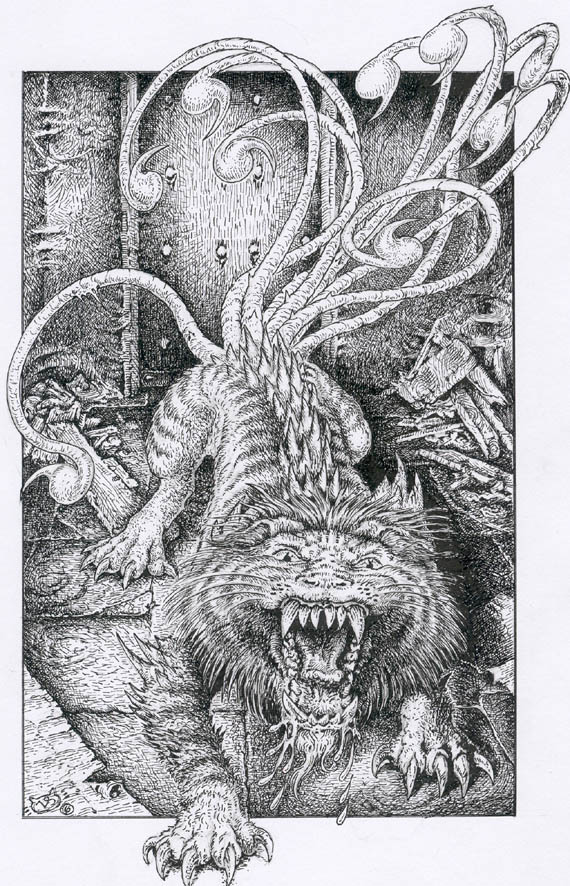
Dragon-like creatures appear in Knights of Doom and Stormslayer, but there are not technically dragons.
There was a dragon in Warlock’s Bounty: Revenge of the Sorcerer, and there was a Zombie Dragon in Shadows over Sylvania.
I do have ideas for various stories featuring dragons, including a Pax Britannia one, but I just haven't got round to writing them yet.
I gave the old explorer's adage 'Here be Dragons' a twist with my Doctor Who novel Terrible Lizards, and I intend to revisit that concept later this year, in Neverland.
That's what one reviewer had to say about my last Fighting Fantasy gamebook Night of the Necromancer:
"This book is probably the best Fighting Fantasy book since Vault of the Vampire. If you like dark eerie, mysterious and atmospheric gamebooks of this series, and you thought Vault of the Vampire was good, then you will definitely enjoy this book, it may be your favourite yet.
"Other ones you may prefer to read are Dead of Night, Night Dragon, Eye of the Dragon, Revenge of the Vampire, and Howl of the Werewolf.
"This maybe the best gamebook yet, alongside the much overlooked Knights of Doom and Spellbreaker. Spellbreaker had the best story line and challenges and this is up there with that one.
One of the more unusual, unexpected, and unforgettable gigs of my writing career (which is 25 years young this July) was being invited to write the novelisation of Richard 'Kip' Carpenter's unmade teleplay for Robin of Sherwood: The Knights of the Apocalypse.
Whilst writing it early last year, and immersing myself in all things Sherwood again, I was reminded of various landmarks in my life that featured the very best interpretation of the Robin Hood legend on screen, ever!
I was a teenager when the series was first televised. I remember balmy summer evenings, making sure I was back home after playing with my friends in the street to watch Robin of Sherwood, and having to draw the curtains to avoid the sunlight reflecting off the tiny TV screen. I was oblivious at the time to the fact that a fair proportion of the viewing public would be watching it for the tousled, '80s-mullet good looks of the lead actor(s)* - I tuned in to enjoy stories of action and adventure, of derring-do and dastardly deeds, of mysticism and paganism.
It was the magical and supernatural elements of the show that appealed to me the most, and what made the programme so different from all the other on-screen iterations. I thought the addition of the pagan shaman Herne was inspired, I couldn't quite believe the Baron de Belleme was about to carry out a satanic sacrifice on what was purportedly a children's show in Robin Hood and the Sorcerer, I was chilled by the appearance of Cromm Cruac, and I thrilled at the arrival of the gigantic wolf's head in The Time of the Wolf. I particularly delighted at the twist ending to the episode Rutterkin. But most of all I was blown away by The Swords of Wayland, with the angelic figure of Lucifer being summoned via the method of reversed-wax-melting.
When Robin of Sherwood was on, the Sunday morning after would find my friends and I in the local church choir dissecting the incidents of the previous night's episode when we were supposed to be getting ready to sing the anthem at the Eucharist.
Jump forward a few years and I found myself sharing a house with nine other young people in Leamingston Spa, all of us students of Warwick University. It turned out that I wasn't the only one upon whom Robin of Sherwood had made such a big impact. My friend Mike - who everyone called Bez at the time, as you do - was also a fan. Saturdays would often find us trawling the local video hire shop for shockingly-bad horror movies to watch that evening.
But one particular day we made a diversion to WHSmith, where we found Robin of Sherwood on sale in VHS format. Being poor, impoverished students, we decided to go halves on The Swords of Wayland two-parter. Taking it back to our rented house, we watched it for the first time since it had been on TV half a decade or more before - and it was just as good as we all remembered, if not even better, because our mutual friend Dave had a much bigger TV than my parents did at home.
When the time came to leave university, I somehow managed to inherit The Swords of Wayland (I'm still not sure how or why) and it inspired me to shell-out some of my hard-earned cash (I was a published author by then) to buy all three series on video, which were replaced, in time, by DVD box sets.
Robin of Sherwood had a big impact on my writing career, long before I came to write The Knights of the Apolcalypse novelisation. My first published book, the Fighting Fantasy adventure gamebook Spellbreaker, features a band of outlaws, each bearing a moniker that could have easily described one of Kip Carpenter's Merries - Outlaw Leader, Scarred Ruffian, Staff-Wielding Outlaw, Veteran Brigand - and their leader just happened to be in possession of a magic swords. My second book, Knights of Doom, featured a Mercenary Champion, who looked suspiciously like Nasir when he was taking part in Owen of Clun's death game, and even some dodgy mummers.
Later, when I was working as a teacher in West London, I wrote a Christmas production about the history of Christmas**. One scene featured a mummer's play; I adapted the mummer's play from the Robin of Sherwood episode The Lord of the Trees, finished it off in the same style, the play having no ending in the show.
And the tone of the show, the quality of the writing, its heart, its warmth and its humour, has stayed with me ever since. Every couple of years I watch the shows again, in order, and I'm looking forward to introducing them to my children next time. (I listen to Clannad's soundtrack album Legend even more often***.)
Having loved Robin of Sherwood for more than two-thirds of my life (and 'loved' is not a word I use lightly) I am always wary of new adaptations and wonder how some people can dare to do Robin Hood again when the definitive version was produced back in the 1980s. But that said, I have an itch to tackle the legend myself, in my own way, by putting a spin on things. Will it be ready by the time the third Hooded Man convention takes place in 2018? Who knows, but the thing is, it doesn't really matter, because I'm the lucky so-and-so who got to write Robin of Sherwood again, 30 years after the show ended.
Talking of which, because The Knights of the Apolcalypse novelisation wasn't available anywhere outside of the original Indiegogo campaign to fund the audio version, there's no one convenient place for people to leave their comments and reviews. If you would like to do so - and reviews, no matter how brief, are always very valuable and helpful for authors - please feel free to do so in the comments after this blog post. After all, nothing's forgotten...
Here's to you, Mike! :-)
* Something which only really dawned on me when I attended my first Hooded Man convention back in 2014!
*** The show is also responsible for my life-long love of Clannad. I think I possibly wrote Spellbreaker whilst listening to their album Legend on loop!
Come along on the day, and not only could you get Tony to sign YOU ARE THE HERO for you, you might also be able to buy an original piece of FF art from his portfolio. Now that would be some collector's item!
Tony's art features a number of times in YOU ARE THE HERO, just as does the work of Les Edwards - the man who painted both different versions of the UK cover of Caverns of the Snow Witch - and so does the artwork of the artists responsible for the internals black and white illustrations on Caverns, Edward Crosby and Gary Ward.
Today is St George's Day, World Book Night, and William Shakespeare's 450th birthday!
Having studied various Shakespeare plays throughout my school years the Bard's work inevitably ended up influencing my own creative endeavours, none more so than my Fighting Fantasy gamebooks.
It all began with the first proposal I sent to Puffin Books, Outlaws of Kaan. Even though that adventure was not meant to be, elements of it were recycled in everything from Spellbreaker and Knights of Doom, right through to Night of the Necromancer.
The more obvious Shakespearean influences in my gamebooks include the witches from Spellbreaker (obviously Macbeth), Belgaroth and his fiend-like queen from Knights of Doom (also Macbeth), Balinac and Erasmus's Cell on Bone Island in Bloodbones (The Tempest), as well as Valsinore Castle and a certain ghost in Night of the Necromancer (Hamlet).
Balinac, by Tony Hough.
There are others, some of which are more obscure than others. For example the Spirit Beast on Bone Island in Bloodbones is based on the invisible monster in '50s sci-fi classic Forbidden Planet, which was itself based on The Tempest, the invisible monster being that particular movie's take on Prospero's slave Caliban.
In last week's Gamebook Friday blog post I mentioned that I had received a rather lovely email from a fan about Knights of Doom, my second Fighting Fantasy adventure. After going all weak at the knees I drifted on to Amazon and found a review of the book, post over a year ago, but 19 years after the book was first published!*
Here are some of the choicest morsels that I have been savouring:
The storytelling, the atmosphere and the quality of writing are superb. This is an adventure that draws in and fully engrosses the reader. It also seems strangely epic, feeling far longer than can be contained in the standard 400 paragraphs...
As usual Green's characterisation is spot on. Every ally is genuinely believable and three dimensional and the villains range from treacherous humans to grotesque beasts to undead menaces... If you are looking for a lengthy, engrossing adventure that reads a little bit more like a novel than usual then this gamebook is ideal. It is a strong addition to the Fighting Fantasy series and an excellent second adventure from the author. After this and 'Spellbreaker' it is little surprise that Jonathan Green has written most of the new adventures in the re-released series...
I've recently discovered a new review of Night of the Necromancer on Amazon. It's always pleasing when people discover your work for the first time, and even more so when it's some years since the book first came out. And then to get a 4-star review too! (Of course, a 5 would've been nice, to go with the other six the book has on Amazon.) Here are some of the highlights:
Starting with 1982's The Warlock of Firetop Mountain, I grew up on the Fighting Fantasy gamebooks. Most of the first eleven were excellent... After that it all got a bit samey, with the odd honourable attempt at innovation such as Steve Jackson's own Creature of Havoc (#24 in the original series), until #40 ("Dead of Night") and the arrival of one Stephen Hand, an unsung hero who partly revitalized the series with two more complex, better-written and just plain more interesting gamebooks (Legend of the Shadow Warriors and Moonrunner). Fast-forward many years and suddenly, after three nights of adventure, I just died while trying to complete "Night of the Necromancer", part of the recent Fighting Fantasy revival, and a book by one Jonathan Green, whose writing style and game design remind me strongly of that of the aforementioned Stephen Hand. My death, in a way, is appropriate, because the premise of this highly original gamebook is that you are already dead -- you play a crusader murdered on his way home to his domain in the kingdom of Ruddlestone...
Suffice to say that "Night of the Necromancer" is about as original a take on the Fighting Fantasy template as I can imagine, chock-full of undead, and epic beyond belief, cramming more into its 450 (sic) paragraphs than you will find in a whole slew of other gamebooks (and knocking a 939-reference monstrosity like DestinyQuest into a cocked hat). Without revealing anything more about its plot, what I will say is that "Night of the Necromancer" will give you about as much non-linear adventuring and freedom of choice as anyone has a right to expect from the limited format of a gamebook, and storms along at a breakneck pace as you only just meet that challenge, only just defeat that monster, only just make it to the next paragraph -- exactly what I want from a gamebook... This is the best gamebook published in many years, and I fully intend to check out Jonathan Green's other books in the future.
It is fitting that the author of the review notices the similarities between my writing style and Stephen Hand's, as Stephen's books were a huge influence on me when I was forging my path as a gamebook designer.
Another book you probably won't be able to pick up (so one that would make an ideal candidate for app conversion by Tin Man Games) is my second FF adventure, Knights of Doom. A fan recently wrote to me about the book and the contents of his email left me with a warm glow in my heart. Here's what he had to say:
Dear Jonathan, On a whim I played through Knights of Doom this week. Like many people I
was obsessed with these books with a child, and now only read one once
in a blue moon, though I wish I had the time to indulge in that sort of
nostalgia more often.
Rereading FF from an adult perspective is a bit odd; I think I keep
expecting to be whisked immediately back to being 12 or so and have
precisely the same feelings about what I'm reading as I did then. But in
my experience it's often a little disappointing. Some of the books feel
rather flimsy, and the mechanics a bit straightforward and not
particularly imaginative. Not so here! This really was an experience like the best of those I had
way back when, and I was once again amazed by how a slim volume could
hold a story that felt so big (some of the later FFs did manage this,
but not at all many), as well as being consistently involving, and
imaginative not just in terms of plot (and in terms of having properly
developed sub-plots as well, which do wonders for the sense of scale)
but in terms of the intricate game mechanics too. It makes for one of
the most engaging FF experiences of all I think. Tony Hough's wonderful
illustrations can take some of the credit too, of course. I can't disagree with the commonly held view that the book is hideously
difficult (naturally I played it without dice etc, and even then had to
cheat as I'd not encountered all the relevant items or bits of
information). But overall I was left with the impression that it's a
great achievement on your part, and a great experience for the reader
(even an adult reader), and it gave me the chance to have a really
rewarding nostalgia trip for once. So, thank you for this book, and indeed for your others. And, naturally,
I'm looking forward hugely to You Are The Hero.
Tony Hough is my some time collaborator, having worked together on the Fighting Fantasy adventure gamebooks Knights of Doom, in 1994, and Bloodbones in 2006. And, unbelievably, today he is celebrating his half century!
Happy Birthday, Tony! Here's to working with you again in the future...
And very kind about it he is too. Knights of Doom has something of a reputation for being - how shall I put this? - a little tricky, so it makes a nice change to hear someone praising the positive elements of the story for a change.
Knights of Doom is unusual, because it's the only Fighting Fantasy gamebook of mine that's not seen print in the new Wizard books format and is hard to get hold of. So if you have fond memories (or otherwise) of the book, or you're wondering what all the fuss is about, follow this link to read Mr Ecclestone's playthrough.
Over on the Unofficial Fighting Fantasy Forum you will find a thread in which fans of the FF phenomenon attempt to sum up various titles from the series in four words. If you know anything about the FF gamebooks, it's a fun read, but the ones I'm posting here are all to do with my books.
Why not try coming up with your own four word summation of books in the series and then post them here, or on the forum? Perhaps you could be the first to come up with something for Spellbreaker, Curse of the Mummy, Bloodbones or Stormslayer.
This is the most recent French translation of one of my gamebooks, the last being Knights of Doom (or rather Les Chevalier du Destin) towards the end of the 1990s, and I'm really excited to see what our Gallic cousins make of 'The Pirate of the Beyond'.
In other over-the-Channel-related news, Le Grimoire Publishing has opened an Art Gallery offering unique artworks by legendary gamebook artists Gary Chalk and Russ Nicholson for sale (including a number by Russ from the FF universe).
You can find out more about Le Grimoire Publishing's endeavours here, and you can keep up to date with the release of Le Pirate de l’Au-delàhere.
As well as being World Book Night and Shakespeare's birthday, today is also Saint George's Day, of course. England's patron saint was a native of the Middle East and is best known now for killing a dragon that, we are told, had something of a taste for princesses.
I haven't written any stories featuring Saint George and the Dragon (other than a piece I wrote at school when I was 14 or 15, or thereabouts), but I have written a few featuring knights and, naturally for a fantasy writer, dragons.




.jpg)


